
Before it became the face of global protest movements, the Guy Fawkes mask was the vision of two British comic book artists who were furious about Margaret Thatcher. Here is the full story of how V came to exist.
“Remember, remember the fifth of November, the gunpowder treason and plot. I know of no reason why the gunpowder treason should ever be forgot.”
That rhyme is more than four centuries old. It was written to mark the failure of the Gunpowder Plot of 1605, when a group of Catholic conspirators attempted to blow up the Houses of Parliament and kill King James I. For hundreds of years it was recited by English schoolchildren and repeated around bonfires on Guy Fawkes Night. Then, in 1982, two British comic book artists borrowed the face of the man at the centre of that plot and turned it into something the world had never quite seen before.
Today the smiling white mask with its thin moustache and pointed beard appears at protests on every continent. It has been worn by members of Anonymous, by Occupy Wall Street demonstrators, by activists challenging government surveillance, and by protestors from Hong Kong to Brazil to Egypt. It is one of the most recognisable symbols of resistance in the modern world.
But if you think V for Vendetta is just a film, you have only seen a fraction of the story.
Britain in the early 1980s
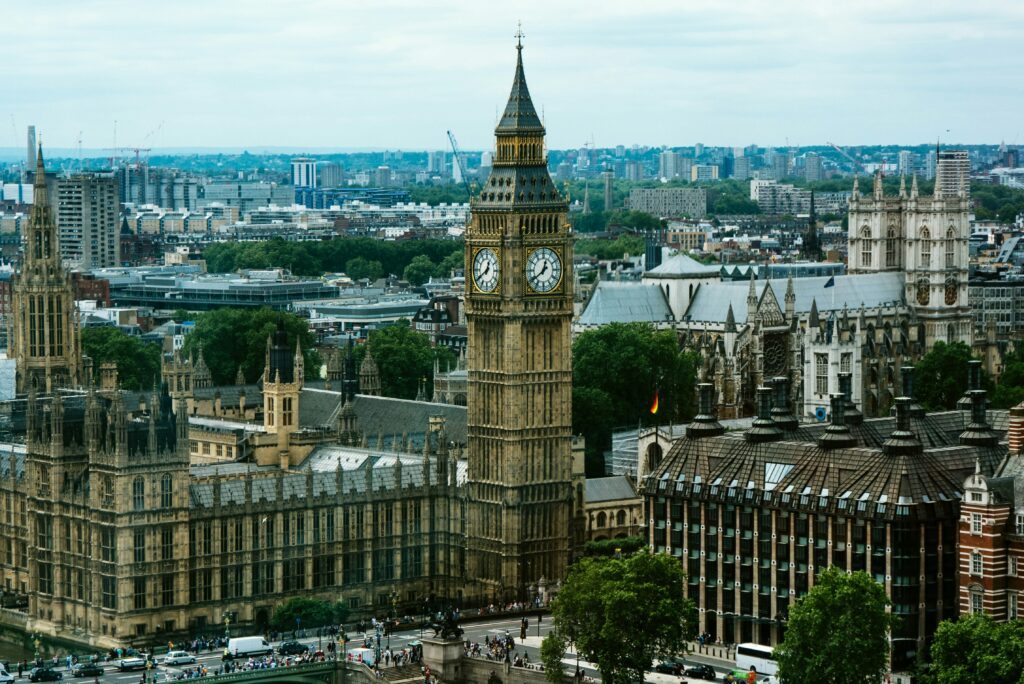
To understand where V came from, you need to understand what Britain felt like in the early 1980s. Margaret Thatcher had come to power in 1979 on a platform of economic reform, and her government’s policies were reshaping the country at a pace that left millions of people disoriented and angry. Unemployment had risen sharply. Industrial communities were being hollowed out. Street clashes between police and protesters were becoming a regular feature of British life. There was a pervasive sense, particularly on the left, that something fundamental about the country was being dismantled.
It was in this atmosphere that a young writer named Alan Moore, living in Northampton, began developing an idea that had been forming in his mind since the summer of 1981. Moore was 27, politically engaged, and possessed of what he would later describe as an anarchist philosophy. He had been asked by Dez Skinn, the editor of a new British comics anthology called Warrior, to contribute a strip. Moore had been working on another idea entirely, but in conversation with an illustrator named David Lloyd, something different began to take shape.
What emerged from those conversations was not what either of them had originally intended. Lloyd and Moore had initially discussed creating something in the vein of a 1930s noir thriller, but the political climate around them kept pulling the story in a different direction. Moore would later be direct about the source of the material: V for Vendetta was a product of the Thatcher era. The anger and anxiety of that moment in British history is embedded in every page.
The birth of a character
The world Moore and Lloyd built is set in a near-future Britain that has survived a limited nuclear war only to fall under the control of a fascist regime called Norsefire. The country they imagined was one of surveillance, censorship, concentration camps, and state-sanctioned hatred of minorities and political dissidents. It was, in Moore’s own framing, an extrapolation of where he feared Britain was heading. He was not predicting the future. He was issuing a warning about the present.
Into this world they placed V, a figure who had survived the regime’s internment camps and returned to wage a one-man war against the state. V is an anarchist, not a conventional hero. Moore was deliberate about this. The tension at the heart of the story, which the 2005 film softened considerably, is not between good and evil but between two forms of extremism: fascism and anarchy. Moore never wanted readers to feel entirely comfortable with V. He wanted them to think.
The character’s visual identity was David Lloyd’s contribution. Early designs for V had followed the conventional superhero template, which felt wrong for what the story was trying to do. Then Lloyd had a different idea. Guy Fawkes, the Catholic militant who had been caught in the cellar beneath the Houses of Parliament in 1605 surrounded by barrels of gunpowder, had been remembered in British culture simultaneously as a traitor and a rebel. His face, stylised and masked, carried exactly the right kind of historical weight. It was English, it was subversive, it had four centuries of resonance behind it, and it sat in a fascinating moral grey area that matched the character Moore was writing.
The mask Lloyd designed was not a faithful reproduction of Guy Fawkes’s face. It was an abstraction, a theatrical simplification, that drew on the traditional images used in Guy Fawkes Night celebrations and transformed them into something more archetypal. The smile, in particular, was a deliberate choice. A smiling face beneath a mask, in the context of violence and rebellion, is unsettling in exactly the right way.
From comic book to cultural symbol
V for Vendetta began appearing in Warrior in September 1982, published in stark black and white. It ran until 1985, when Warrior folded before the story could be completed. Several years of uncertainty followed, during which Moore and Lloyd attempted to find a publisher willing to let them finish the work. DC Comics eventually stepped in, reprinting the original material in colour and publishing the concluding chapters between 1988 and 1989.
The complete collected edition found a devoted readership, but V for Vendetta remained a celebrated graphic novel rather than a mainstream cultural phenomenon for the next decade and a half. That changed in 2005, when Warner Bros. released a film adaptation directed by James McTeigue from a screenplay by the Wachowskis, with Hugo Weaving as V and Natalie Portman as Evey Hammond.
Moore himself was characteristically unhappy about the adaptation. He had already been in dispute with DC Comics and its parent company Warner Bros. over the rights to his work, and he felt the film had fundamentally altered the political message of the original story. Where his graphic novel had placed fascism and anarchism in direct opposition, Moore argued the film had recast the story as a conflict between liberalism and neoconservatism, stripping out the genuine radicalism that gave the work its edge. He asked for his name to be removed from the film’s credits, and it was.
David Lloyd took a different view. He praised the adaptation warmly and said it was a “fantastic representation” of the work they had done together. The two creators who had built V for Vendetta from the same anxious moment in British political history had arrived at very different conclusions about what the story should mean to the world.
How the mask went global
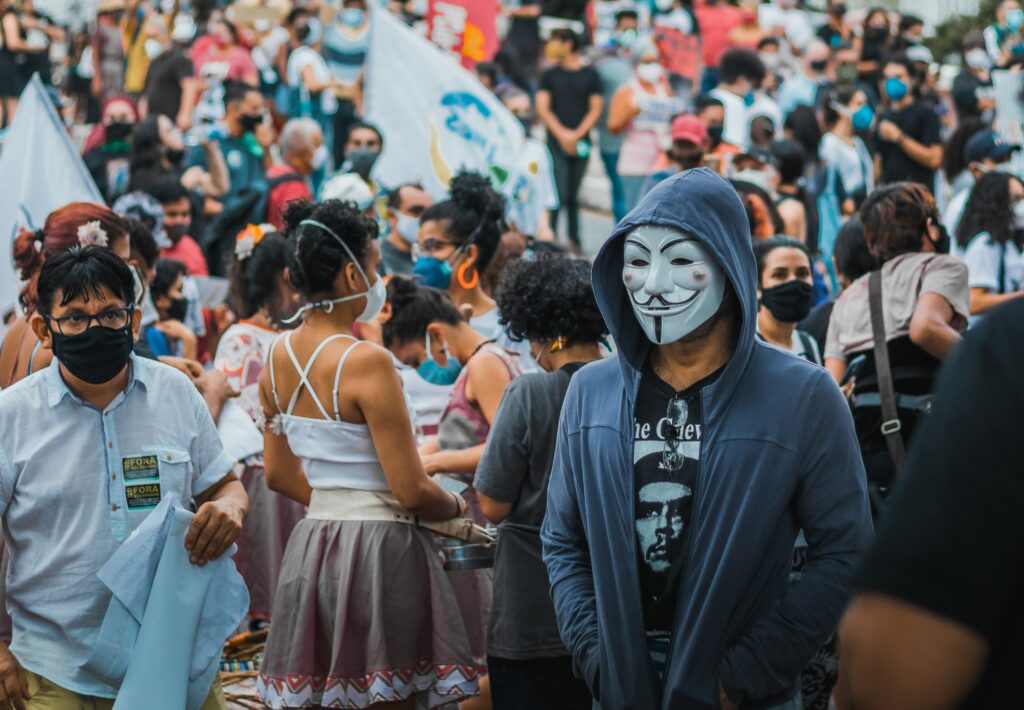
The 2005 film introduced the Guy Fawkes mask to an audience that had never read the graphic novel, and it arrived at a moment when the political conditions for its adoption were already forming. In 2008, the hacktivist collective Anonymous began incorporating the mask into its public actions, particularly in protests against the Church of Scientology. The image spread rapidly. By 2011, when the Occupy Wall Street movement emerged in New York and spread to cities around the world, the mask had become the visual shorthand for a generation of protest that was skeptical of established institutions and angry about economic inequality.
What happened next was something neither Moore nor Lloyd had anticipated, and which carries its own irony. The Guy Fawkes mask is manufactured and sold by Warner Bros., which owns the rights to the design as part of the film’s intellectual property. Every mask purchased by a protester anywhere in the world generates a royalty payment to the corporation that owns the film adaptation of a story created as a critique of corporate and state power. Moore has noted this fact with the dry amusement of a man who has long since stopped expecting the world to be consistent.
The mask has appeared in contexts that range far beyond the political left that originally adopted it. It has been worn by protesters against COVID restrictions, by participants in the January 6th Capitol events in Washington, and by activists whose politics would have been unrecognisable to Alan Moore in 1981. The symbol has drifted so far from its origins that it now functions less as a coherent political statement than as a general expression of anti-establishment feeling, whatever form that feeling happens to take.
What V actually is
This drift is perhaps the most interesting thing about V for Vendetta’s legacy, and it connects back to something Moore understood from the beginning. He did not write V as a character with a specific political programme. He wrote V as an idea. The mask is designed to be worn by anyone who feels that power is being used against them. It is, by design, a blank face onto which any rebellion can be projected.
That universality is what has made it last. Characters created for a single story in a single moment tend to stay within that story. Ideas escape. They find new contexts, new meanings, new wearers. Moore and Lloyd drew on a four-hundred-year-old English Catholic militant to create a masked anarchist for Thatcher’s Britain, and somewhere in the process they created something that belongs to no particular time or place.
The rhyme is still recited. The bonfire is still lit. And the mask, smiling its permanent smile, keeps appearing in places its creators never imagined, worn by people who may never have read a single page of the comic book that gave it to the world.
Some characters are born within a story and die within it. V was never going to be one of those.