
The Safdie brothers’ 2019 film is two hours of pure chaos on the surface. Underneath it, there is something close to a philosophy about luck, ambition, and the things we convince ourselves we deserve.
The Safdie brothers’ 2019 film Uncut Gems is, on its surface, two hours of barely controlled chaos. Adam Sandler plays Howard Ratner, a New York jeweller who spends the entire runtime making one bad decision after another, each one slightly worse than the last, while the people around him slowly run out of patience. It is an exhausting film to watch, in the way that watching someone you care about repeatedly walk toward a cliff edge is exhausting.
And yet underneath all of that chaos, there is something that looks remarkably like a philosophy, if you are willing to sit with it for long enough.
The stone that will not let him go
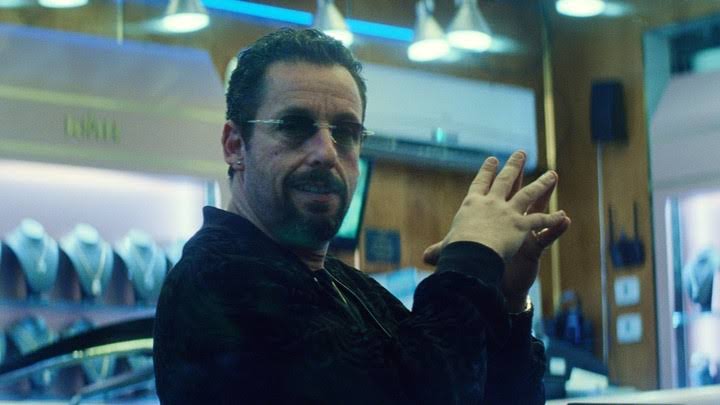
The film opens with Howard undergoing a colonoscopy, and the editing strongly implies that something is seriously wrong with him. Later, a doctor calls to tell him everything is fine. One way to read this is that the opal Howard has acquired, the uncut gem of the title, has effectively replaced his mortality with something else. He no longer has the right to an ordinary fate. The stone has taken that from him, and given him something else in return, something he never asked for and does not fully understand.
What follows is a pattern that repeats throughout the film with an almost mathematical precision. Whenever the stone is out of Howard’s hands, in the possession of basketball player Kevin Garnett, things tend to work out for Howard, even if only briefly. The first time Garnett holds the stone, Howard places a bet based on his faith in Garnett’s performance and wins, only for his creditors to intercept the money before he can collect it. The second time Garnett holds the stone, Howard bets again, wins again, and this time the consequences are fatal.
The pattern suggests something uncomfortable. The moments when Howard is closest to getting what he wants are the moments when he has, in some sense, let go. The moment he reclaims full possession of the stone and everything it represents is the moment everything ends.
The value of things that mean nothing to anyone else
There is a small but telling detail late in the film when the opal, the object that has consumed Howard’s entire existence for the runtime of the movie, sells at auction for far less than he believed it was worth.
This detail works as a kind of quiet commentary on the things that define our lives. The objects, goals, and obsessions that feel central to our identity, that we have organised our entire existence around, often mean very little to the world outside our own heads. Howard has risked his marriage, his business, and ultimately his life for an object whose value, to everyone except him, turns out to be ordinary.
Why we stop feeling sorry for him
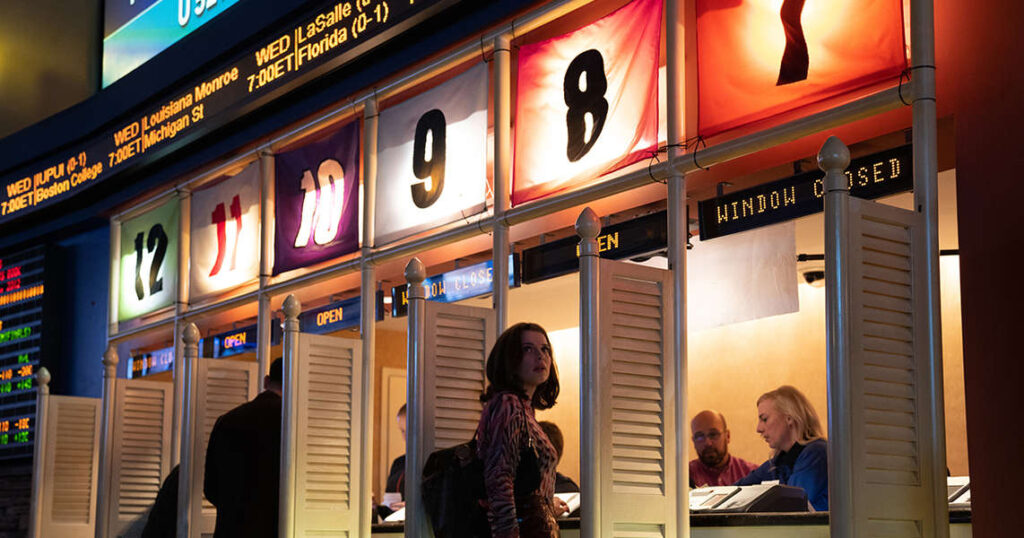
For much of the film, the audience is positioned to worry about Howard. He is in genuine danger, his choices are getting worse, and the consequences feel like they are closing in. But somewhere in the middle of the film, that concern tends to curdle into something else. Frustration. Irritation. The sense that whatever happens to Howard next, he has more or less earned it.
This shift happens because we come to understand something about Howard that the film never states directly. He does not change. Each time he is given an opportunity to step back, to take the smaller win, to make the safe choice, he does not take it. People like this exist in real life in considerable numbers, and one of the things Uncut Gems captures accurately is the particular exhaustion of being near someone like that. You cannot fix every hole in their life. You cannot stay ahead of every consequence they are creating for themselves.
And yet the film also points at something else worth sitting with. Howard, for all his chaos, is living an objectively glamorous life. He drives an expensive car, lives well, and spends time with celebrities including Kevin Garnett himself. Meanwhile, the film opens in an Ethiopian mine, where a worker is badly injured retrieving the very stone that Howard will spend the film obsessing over. The film does not dwell on this worker. Neither, really, do we. The contrast between how much sympathy we extend to Howard and how little we extend to the person whose injury set the entire plot in motion is, perhaps, the most quietly devastating thing in the entire film.
The dark side of ambition
At its core, Uncut Gems is a story about what unchecked ambition does to a person and the people around them. Howard’s choices throughout the film consistently endanger both himself and his family, and the film never lets him, or the audience, forget that these are choices. No matter how chaotic the plot becomes, the consequences of those choices remain entirely logical. You reap what you sow, even when the sowing looks like nothing more than a series of increasingly reckless bets.
The film also makes a quieter point about the impermanence of money and luck. Howard’s fortunes rise and fall throughout the film with dizzying speed, and at no point does any of it feel stable. Money arrives suddenly and disappears just as fast. Luck holds for a moment and then does not. Nothing in the film’s universe rewards Howard for staying still, and nothing in his character allows him to.
A world built on small deceptions
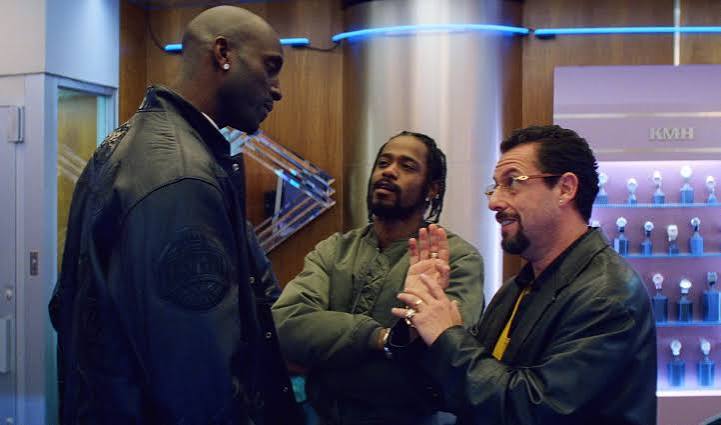
One of the quieter throughlines in Uncut Gems is how much of the story is built on people trying to convince each other, and themselves, of things that are not quite true. Buyers and sellers negotiate prices that both parties know are inflated or deflated. Bets are placed on the basis of feelings dressed up as certainty. Kevin Garnett’s belief that the opal carries some kind of power for him is never confirmed or denied by the film, but it shapes his decisions as though it were fact.
Howard himself operates almost entirely within this space. He tells the people closest to him, his wife, his mistress, his business partners, versions of the truth calibrated to keep them calm or keep them moving in the direction he needs. Whether he believes these versions himself is one of the more interesting ambiguities the film leaves unresolved.
The image that completes the film
In the film’s final moments, blood from Howard spreads across the floor in a way that visually echoes the swirling, galaxy-like patterns we saw inside the opal at the very beginning of the film. It is a striking piece of visual rhyme, and it suggests something about how the film wants us to think about Howard himself.
Perhaps Howard was, in his own way, an uncut gem. Someone with real potential, real charisma, real ability, who never found a way to refine any of it into something that could last. The thing of value inside him never got the chance to become what it might have been.
What the film leaves you with
Uncut Gems does not offer a tidy lesson, but it does leave you with something to think about. If your fortunes suddenly improve, dramatically and quickly, it is worth being cautious about what you do with that. Within a system built on chance, the next loss is always somewhere ahead of you, waiting.
Behind every story of someone who got lucky, there are quieter stories of people who did not. The film asks you to notice this, even as it builds its entire structure around a character who, for the most part, refuses to.
Some people end up exactly where their choices were always going to take them. Others get there by accident, carried along by forces they never understood. Uncut Gems never quite tells you which one Howard was. That ambiguity, more than anything else, is probably the point.