
The observable universe stretches 93 billion light years in every direction. But according to physics, almost none of it is actually within our reach and the window is closing faster than you might think.
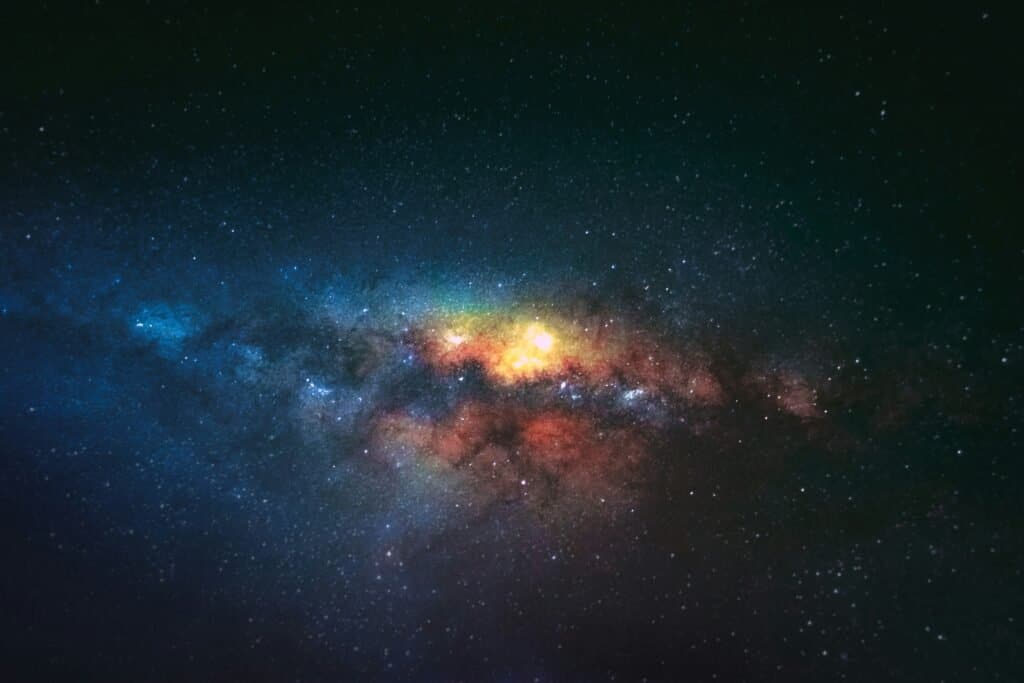
Picture the night sky on a perfectly clear evening, far from any city, with the Milky Way stretched overhead like a river of light. It feels infinite. It feels like everything. And in a sense, it is everything we will ever know because according to our best understanding of physics and cosmology, almost all of the universe beyond what we can see right now is not just distant. It is permanently, irreversibly gone.
Not gone as in destroyed. Gone as in unreachable. Forever.
The numbers are staggering. Roughly 97% of the galaxies in the observable universe are already beyond any hope of visitation, contact, or even communication not because we lack the technology to reach them, but because the universe itself has placed them beyond any boundary we could ever cross. And that boundary is not standing still. Every year, more of the cosmos slips beyond our grasp.
Understanding why this is true requires stepping back and thinking about what the universe actually is, and what it is doing right now.
The Universe Is Not Sitting Still
Most of us grow up with a mental image of the universe as a vast but essentially static place an enormous dark room filled with stars and galaxies, waiting to be explored. That picture is wrong in a fundamental way.
The universe is expanding. Every galaxy not gravitationally bound to our own is moving away from us, and the further away it is, the faster it recedes. This was first observed by Edwin Hubble in 1929, and it has been confirmed and refined countless times since. But the expansion of the universe is not like objects flying through space away from each other. It is space itself that is stretching. The fabric of the cosmos is getting larger, and the galaxies are being carried along for the ride.
This distinction matters enormously, because Einstein’s theory of relativity sets a firm speed limit for anything moving through space — nothing with mass can reach the speed of light, and no information can travel faster than it. But that rule applies to objects moving through space, not to the expansion of space itself. Space can expand at any rate it likes. And in the case of galaxies far enough away, the expansion of the space between us and them means they are receding at speeds that exceed the speed of light.
This is not a violation of relativity. It is simply what happens when enough space is expanding between two points at once.
THE Line We Can Never Cross
There is a boundary in the universe known as the cosmic event horizon. As of our best current measurements, it sits at roughly 16 to 18 billion light years away from Earth. Any galaxy beyond that distance is receding faster than light can travel, which means that even if we launched a spacecraft today capable of moving at the speed of light, it would never close the gap. The space between us and those galaxies would continue to grow faster than we could travel through it.
Think of it this way. Imagine walking towards a door at the end of a hallway, but the hallway itself is stretching beneath your feet faster than you can walk. No matter how long you keep moving, the door gets no closer. That is the situation facing any theoretical spacecraft aimed at the vast majority of galaxies in the observable universe.
When cosmologists calculate the actual volume of the observable universe that lies within this reachable boundary, the number is humbling. Only about 6% of the volume of the observable universe the closest 6% is presently reachable by us. Some researchers frame it differently, noting that we could send signals to roughly 3% of the galaxies we can currently observe before the expanding space between us makes even communication impossible. Either way, the point is the same: the overwhelming majority of what we can see is already beyond our reach.
Dark Energy And The Accelerating Problem
Here is where things get genuinely unsettling. The expansion of the universe is not slowing down. It is speeding up.
In 1998, two independent teams of astronomers made a discovery so unexpected that it upended cosmology. They were studying distant supernovae, expecting to find evidence that gravity was gradually slowing the universe’s expansion. Instead they found the opposite the expansion was accelerating. Something was pushing the universe apart, and pushing harder over time. That something is what physicists now call dark energy, a mysterious force that appears to be woven into the fabric of space itself, and which currently accounts for roughly 68% of the total energy content of the universe.
We do not fully understand what dark energy is. What we do know is what it does: it drives galaxies apart at an ever-increasing rate, and it has been doing so for billions of years. Because of this acceleration, every year, about 160 billion stars spread across countless galaxies slip beyond the event horizon, joining the portion of the universe we can never reach.
Every single year. 160 billion stars. Permanently beyond contact.
WHAT REMAINS
So what does humanity actually have access to? The answer is a structure called the Local Group a gravitationally bound collection of roughly 50 to 80 galaxies, including our own Milky Way, the Andromeda galaxy (which is on a slow collision course with us, expected to merge in about 4.5 billion years), and a collection of smaller dwarf galaxies orbiting both. These are the galaxies that gravity has bound together tightly enough that the expansion of space cannot pull them apart. They are our permanent cosmic neighbourhood.
Beyond the Local Group, the picture changes. In the distant future, only galaxies within our Local Group will remain gravitationally bound to us. The rest of the universe will drift away, leaving us in a cosmic bubble of isolation.
This is not a temporary situation. It is the permanent destiny of any civilisation that happens to exist anywhere in the universe.
THE UNIVERSE FUTURE CIVILISATIONS WILL NEVER SEE
There is a dimension to this story that is easy to overlook, and it is perhaps the most philosophically striking aspect of all.
The galaxies we can observe today with our telescopes the billions of galaxies spread across the cosmic web, visible in images from the Hubble and James Webb space telescopes are visible to us because their light had time to reach us. We are seeing them as they were billions of years ago, not as they are now. Many of them have long since crossed the cosmic event horizon. We can see their ancient light. We can never reach them, and we can never know what they look like today.
Now consider what happens in the very far future. As dark energy continues to drive everything apart, the light from more and more galaxies will be stretched to such extreme wavelengths that it will effectively become invisible, too faint and too redshifted to detect. Extrapolating the model into the far future predicts a universe consisting solely of our Milky Way. Light from distant galaxies will be redshifted so much as to become invisible. Thus observational evidence for cosmology will be unverifiable.
Any civilisation that arises billions of years from now, looking up at the sky with their own telescopes, will see only darkness beyond their own galaxy. They will have no observational evidence that other galaxies ever existed. They will have no way of knowing that the universe once contained billions of them. The grand, intricate structure of the cosmos the cosmic web, the galaxy clusters, the deep field images showing thousands of galaxies in a patch of sky the size of a grain of sand will be entirely invisible to them.
We live in the brief window of cosmic time when all of it can still be seen.
A PRIVILEGE DISGUISED AS A LIMITATION
It is tempting to read all of this as purely discouraging a story about everything that is impossible, about a cosmos that is closing itself off to us before we ever had a real chance to explore it.
But there is another way to read it.
We happen to exist at a moment in the history of the universe when the cosmic web is still visible. When billions of galaxies can still be observed in exquisite detail. When the evidence for the Big Bang, for dark energy, for the large-scale structure of the universe, is still right there in the sky for anyone with a telescope to find. The civilisations of the far future, if they exist, will inherit a cosmos stripped of all that evidence a dark and apparently empty universe with no way of knowing what came before.
We are not simply limited observers standing at the edge of an ocean we cannot sail. We are, in a very real sense, the lucky ones the generation of life in the universe that happened to arrive at exactly the right moment to see almost all of it, even if we can reach almost none of it.
The view from here, right now, is extraordinary. And it will not last forever.